
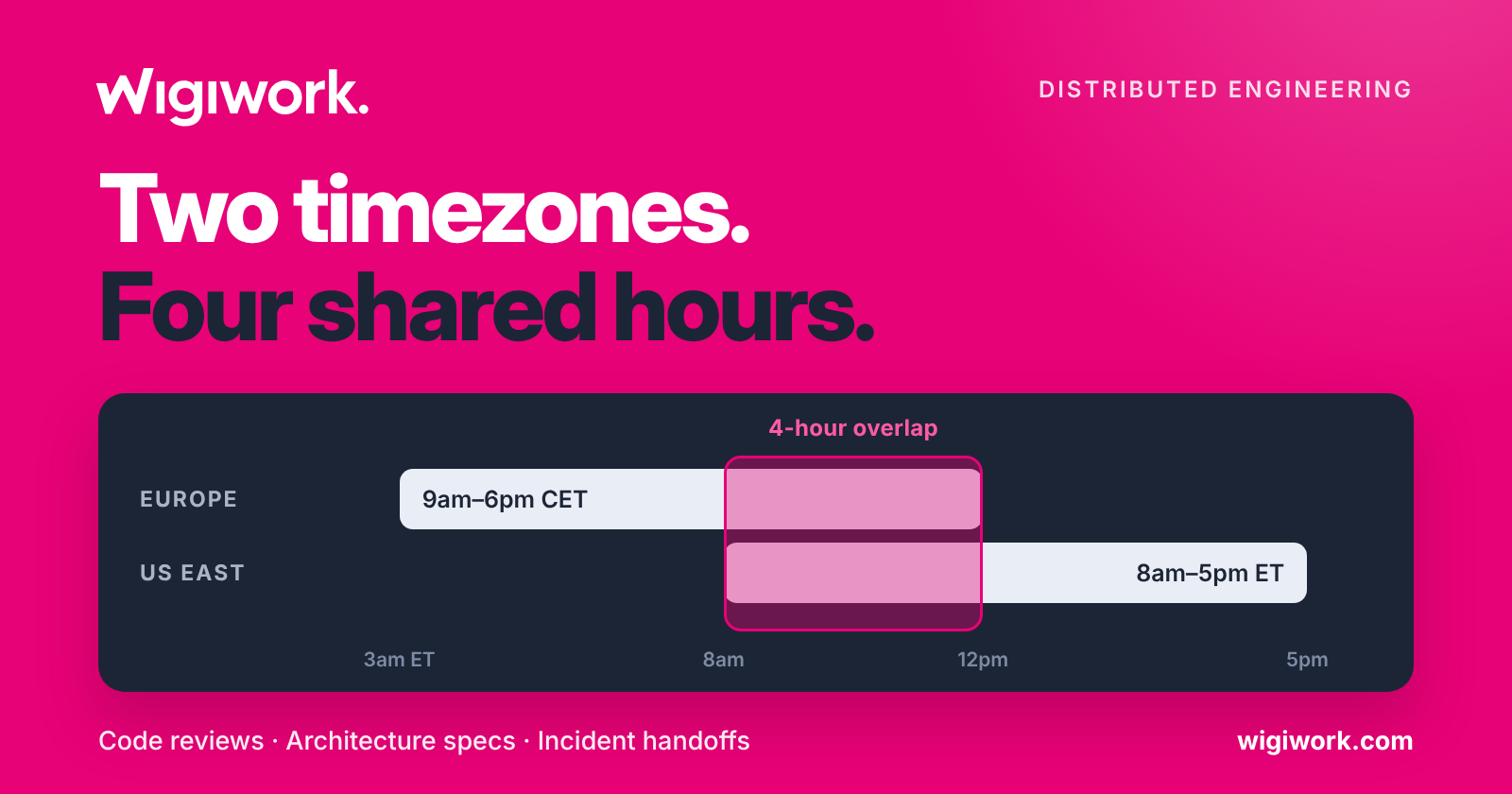
One of the most persistent myths in distributed engineering is that cross-Atlantic teams suffer from 24-hour feedback loops. In practice, senior engineers operating in UK (GMT), Central European (CET), and Eastern European (EET) timezones share a predictable 3-to-5-hour synchronous overlap window every morning with US East Coast (EST) product and leadership teams—while gaining uninterrupted morning deep-work blocks before New York or Boston logs on.
As documented in GitHub's Octoverse research on global developer collaboration, distributed engineering teams match or exceed co-located velocity when they separate deep implementation hours from synchronous architecture sign-offs.
How Should Distributed Teams Structure the US-to-Europe Workday Handoff?
Instead of filling the transatlantic overlap window with status standups, engineering leaders hiring available remote engineers across Europe, the UK, and North America divide the 24-hour cycle into three distinct operational blocks:
| UTC Window | Europe (CET / EET) |
US East (EST) |
Primary Engineering Focus |
|---|---|---|---|
| 07:00 – 13:00 UTC | Morning / Midday | Pre-workday | Deep Build Block: Uninterrupted coding, PR creation, automated CI/CD test runs |
| 13:30 – 17:30 UTC | Afternoon | Morning (08:30–12:30) | Golden Overlap (4h): Architecture pairing, PR sign-offs, production deployments |
| 17:30 – 22:00 UTC | Evening (Offline) | Afternoon | Product & Spec Prep: Ticket refinement, customer telemetry, next-day sprint queue |
What Spec Format Prevents Overnight Slack Bottlenecks?
Cross-timezone velocity drops only when engineers start their morning focus block facing ambiguous acceptance criteria. Adopting lightweight Request-for-Comments (RFC) and ticket definitions inspired by IETF engineering specification standards ensures engineers in Warsaw, Kyiv, Bucharest, or London can ship complete pull requests without waiting six hours for product clarification:
sprint_ticket_spec:
  service: realtime-ledger-worker
  implementer_timezone: EET (UTC+2)
  reviewer_timezone: EST (UTC-5)
  synchronous_overlap_utc: "13:30-17:30"
  definition_of_ready:
    - Idempotent retry handling on upstream webhook timeouts
    - p99 latency under 120ms at 2,500 requests/sec
    - Backwards-compatible OpenAPI v2 response schema
Why Do Senior Engineers Outperform in Asynchronous Corridors?
Junior teams rely heavily on all-day shoulder-tapping; staff and senior engineers with 5 to 10+ years of production ownership thrive on written technical contracts, automated preview environments, and strict CI gates. Pairing NIST Secure Software Development Framework (SSDF) practices with upfront timezone and rate alignment allows distributed hiring teams to ship daily across US, UK, Central European, and Nearshore LATAM corridors without calendar bloat.
About the author
- Wigiwork (https://wigiwork.com) is the AI-native talent marketplace connecting verified hiring companies directly with 145,000+ software engineering, AI/LLM, Cloud/DevOps, cybersecurity, and fintech professionals across remote, hybrid, and on-site roles. Candidates set upfront annual salaries or monthly B2B contractor rates while personal identities stay protected behind pre-approval Wigi Highlights—with 0% staffing agency commissions.
Comments
Join the discussionNo comments yet. Be the first to comment.